
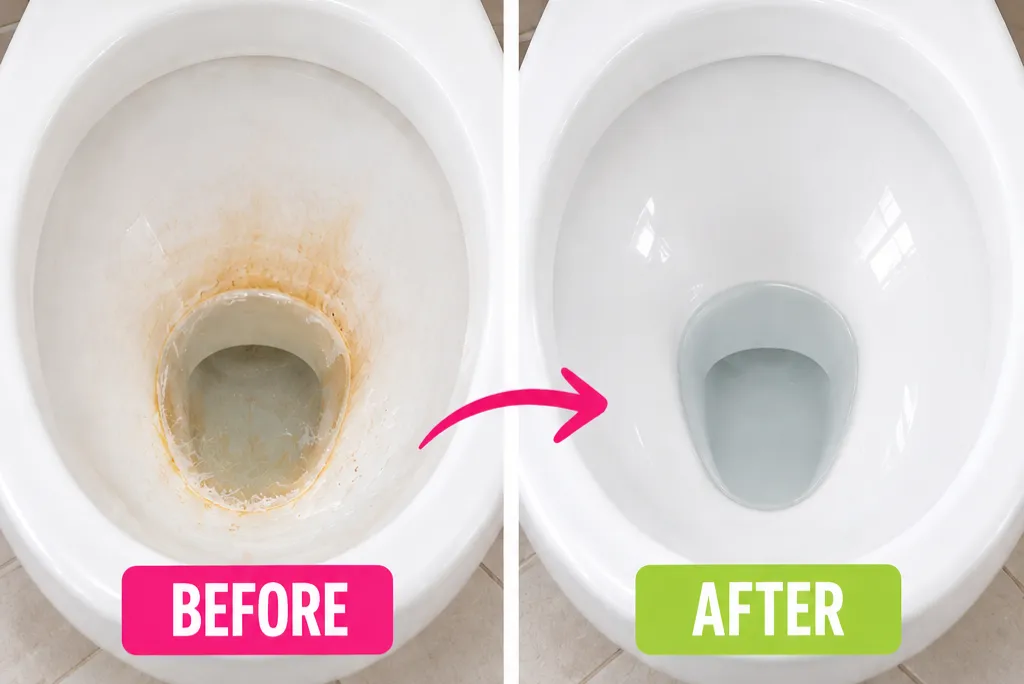
That brownish or grey ring sitting just below the waterline in your toilet bowl isn’t dirt in the usual sense, it’s mineral deposits left behind by hard water, calcium, lime, and iron that build up slowly every time the toilet is flushed. Regular scrubbing with a toilet brush often just glances off it, since minerals bond to porcelain in a way everyday grime doesn’t.
The good news is this ring comes off completely with the right approach. This guide covers a borax and lemon juice soak, a favorite combination among cleaning enthusiasts that barely needs any scrubbing, and a pumice stone method for rings that refuse to budge even after soaking.
At a Glance: Which Method Do You Need?
- Light to moderate staining or a fresh ring? A borax and lemon juice soak lifts it. Head to Method 1.
- Old, stubborn rings that won’t come off with soaking? A pumice stone works through it. Head to Method 2.
Not sure which one you need? Start with Method 1. It clears most staining with barely any scrubbing.
Wear rubber gloves, borax is generally safe but can irritate skin and eyes with direct or repeated contact. Keep it away from children and pets, and avoid inhaling the powder while mixing. And never mix borax or lemon juice with a bleach-based cleaner in the same session, combining acids with bleach releases toxic chlorine gas, stick to one method at a time.
Method 1: Borax and Lemon Juice Soak (Most Effective, No Harsh Scrubbing)
This combination is a favorite among cleaning enthusiasts for a reason, borax is mildly abrasive and alkaline, while lemon juice or vinegar brings the acidity needed to break down mineral deposits. Together, they work through hard water rings without needing much scrubbing at all.
What You’ll Need
- 1 cup borax
- 1/4 cup lemon juice or white vinegar
- Rubber gloves
- A toilet brush
How to do it:
Step One: Turn off the water supply valve behind the toilet, then flush to lower the water level in the bowl. This lets the mixture make direct contact with the ring instead of diluting in standing water.
Step Two: Combine 1 cup of borax with 1/4 cup of lemon juice or white vinegar in a small bowl, stirring until it forms a thick, spreadable paste.
Step Three: Pour or spread the mixture directly onto the stained ring, covering it generously.
Step Four: Let it sit for at least 20 minutes. For stains that have been set in for a long time, leaving it for a couple of hours gives it more time to work.
Step Five: Scrub with a toilet brush, the stain should lift away with much less effort at this point.
Step Six: Turn the water supply back on and flush to rinse everything away.
Method 2: Pumice Stone (For Stubborn, Long-Set Rings)
Use this when a soak alone isn’t clearing the ring, or when the staining has clearly been there for a long time. A pumice stone is mildly abrasive enough to physically break down mineral deposits that soaking can soften but not fully dissolve, without scratching porcelain when used correctly.
What You’ll Need
- A pumice stone made for toilet bowls
- Rubber gloves
How to do it:
Step One: Soak the pumice stone in warm water for 15 to 20 minutes before using it. This softens the stone slightly so it won’t scratch the porcelain.
Step Two: Make sure both the stone and the stained area of the bowl are wet before you start scrubbing. Never use a pumice stone dry, or on a dry surface, that’s when scratching happens.
Step Three: Gently rub the stone over the ring using circular motions, letting the mild abrasion do the work rather than pressing hard.
Step Four: Flush periodically as you work to rinse away loosened debris and check your progress.
Step Five: Once the ring is gone, flush a final time to clear any remaining residue.
A Quick Note on Nearby Natural Stone Surfaces
If your bathroom has a natural stone vanity top, stone flooring, or stone tile near the toilet, keep the lemon juice or vinegar mixture away from those surfaces entirely, their acidity can etch and dull stone permanently, and once that damage happens, it can’t be cleaned away. Wipe up any splashes immediately with a dry cloth if they happen.
For cleaning stone surfaces themselves, use a pH-neutral, stone-safe cleaner instead, it won’t react with or damage the stone the way an acidic mixture would.
A Quick Habit That Helps a Lot
Giving the bowl a quick scrub with a toilet brush once or twice a week keeps mineral deposits from ever having the chance to build into a visible ring. If your home has notably hard water, a toilet bowl cleaner formulated for mineral control, used regularly, slows down how fast new staining forms between deeper cleans.
Whichever method you use, the pattern stays the same, soften the deposits first, then lift them gently rather than scrubbing hard from the start. Stay consistent with regular scrubbing, and you’ll rarely deal with a stubborn ring at all.